KOI CLUB OF SAN DIEGONEWSLETTERJune 2026 |
|
|
Koi Club of San Diego Meeting
June 14th, 2026
Social hour - 12:00 noon - 1:00 pm
Meeting begins at 1 pm
Potluck, bring your own chair
OUR HOSTS WILL BE
Jill and Matt Rhoades 3130 Elliott Street San Diego, CA 92106
|
|
|
|
|
STEERING COMMITTEE MEETING
|
|
|
Wednesday, June 10th at 7:00 pm (earlier if you are ordering food) ALL MEMBERS ARE WELCOME!
Dennys
2691 Navajo Road El Cajon, CA 92020
|
|
|
|
|
Koi Club of San Diego Ponder Profile
by John Svelan, photography by Bill Newell
Matt and Jill Rhoades |
|
|
|
|
Matt, Jill, Cole and their two dogs reside in the San Diego community of Loma Portal; part of the Point Loma community. The quaint home in a quiet neighborhood was built in 1926 by an early San Diegan doctor/businessman. Matt is a retired fourth-grade teacher who taught at Crown Point Junior Music Academy, Jill is a retired accountant and an admirer of koi. She determined, when she started dating such a koi-kichi guy, that it would be beneficial for her to take an interest in koi.
Matt attended his first Koi Club of San Diego meeting in 2003 at the home of Norm Meck and immediately caught the koi bug. Since then, he has been extremely active in the club by serving as Club President, Vice President of both Program and Venue and now holds the record as a sixth time Koi Show Chairman! Matt was also Koi Person of the Year in 2010! Growing up in Mission Beach, when he wasn’t rescuing people from the surf as a lifeguard, he spent lots of time in the water surfing, sailing, and now competes in open ocean outrigger canoe racing. Matt started out on his fish venture with a 15-gallon aquarium, a few early koi pond attempts and as you can see from Bill Newell’s beautiful photographs, he now has a beautiful and high-tech Dream Pond! |
|
|
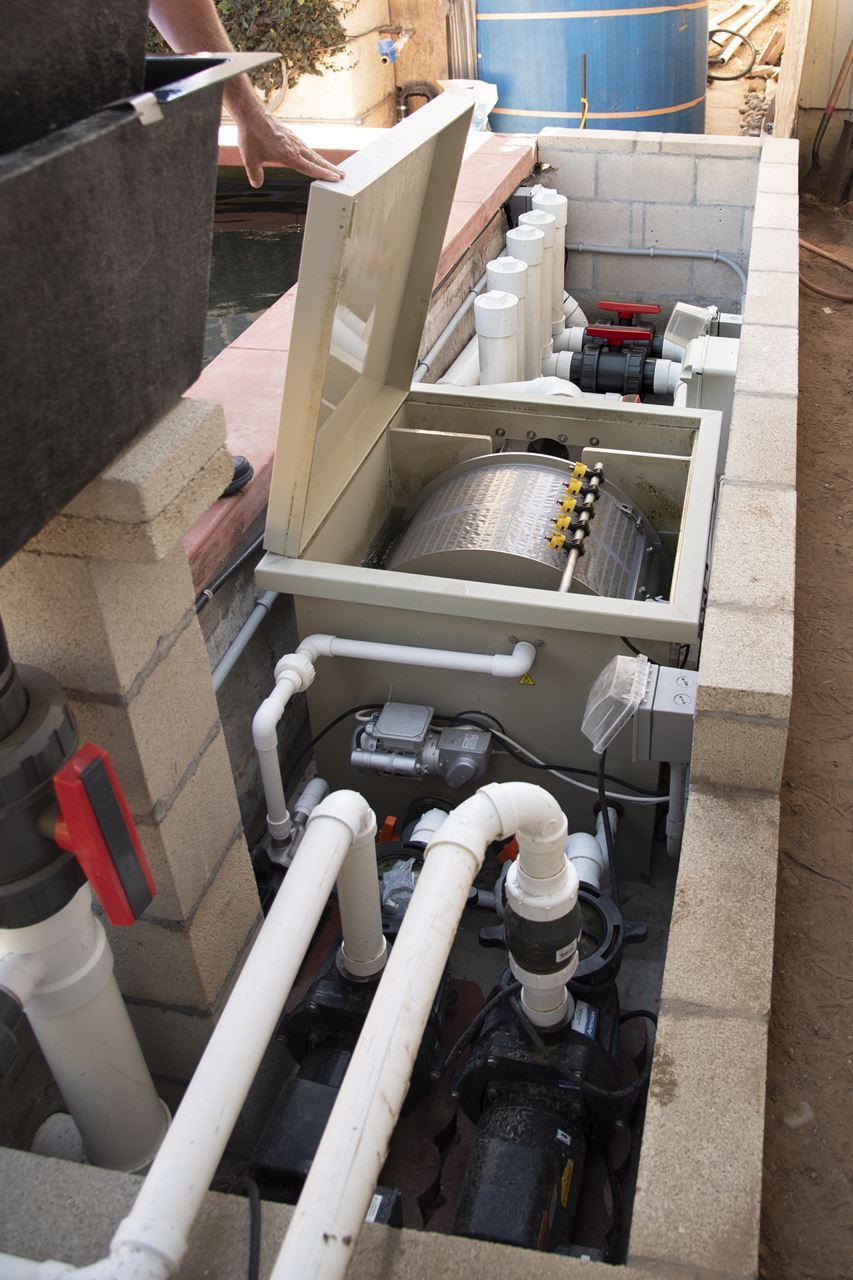
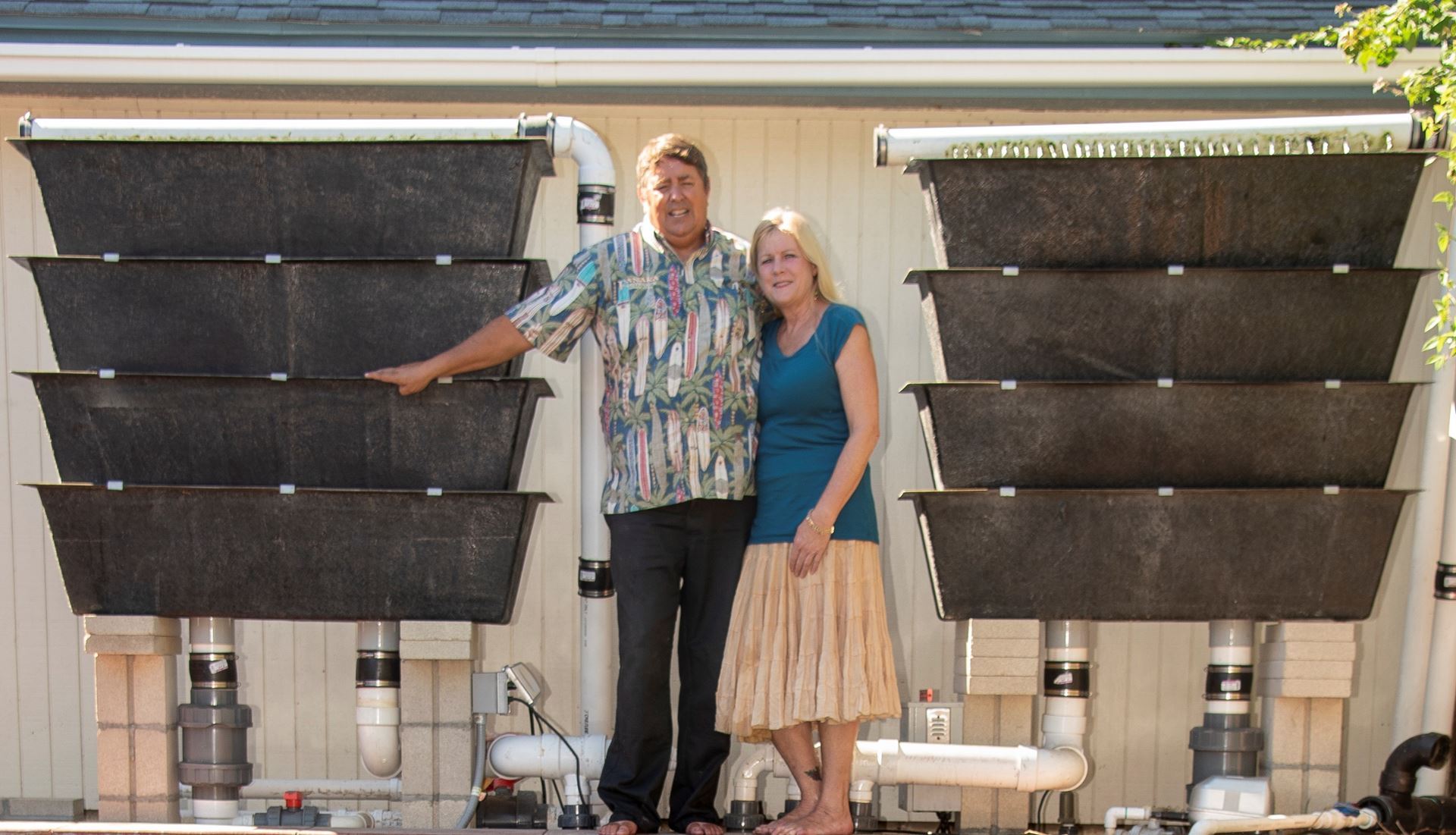
The 15,614 gallon (about 60566.56 L), 8’ deep concrete dream pond was designed and built by Steve “Buck” Buckles with help from Matt and a few sub-contractors. The pond is equipped with the latest technology that includes a Profi Rotary Drum Eco 65/60 mechanical filter, two four-tray large Bakki showers loaded with ceramic media serve as the biological filter, two ½ hp Sequence pumps, an Aqua UV Viper 400-watt UV, large air pump, automatic feeder and the list goes on!
The pond is home to around 25 gorgeous fish who have patiently waited in a plastic |
|
|
swimming pool for three years while building permits were processed and the pond was being finished. Funny… fish don't
|
|
|
really understand all the permitting process stuff. The majority of the fish are from our good friends Ken Liu Barstow Koi and Ben Plonski of Laguna Koi. Matt’s favorite variety is Shiro Utsuri and some are from Omosako Koi
|
|
|
Farm in Japan. Matt loves showing his fish and has shown and won lots of awards in San Diego, as well as Gardena, Bakersfield, and Fresno. In closing, Matt has one of the best senses of humor and always keeps us smiling. “If you’re not having fun, you’re not doing it right.”
Thanks for sharing your Ponder Profile! |
|
|
MAY MEETING PHOTOS
Pat and Lorelei Kelly
by Bill Newell
|
|
|
WELCOME NEW MEMBERS!
Scott and Adelaine Trask
John & Miriam Estrada
WELCOME BACK, RENEWING MEMBERS!
Denise Bargo
Tim Cooke
Richard and Gail Goerisch
Brian and Shawna Gibbs
Afshin & Jamie Karimi
Lorie Mariano & Valerie Kosmicki John Stump & Elizabeth Moore
|
|
|
KHA KORNER
by "Koi Jack" Chapman |
|
|
Sometimes a koi event occurs and I think I should do an article around the subject matter and it’s that time of year for koi spawning. I had my second pond spawning now 12 years ago and wrote about it then and decided to run it again now with a couple changes as we are now in spawning season for most local ponds. So, the last natural spawning in my pond (YUK) was due in part to an error on my part that I’ll save as closing remarks. After your first pond spawning most koi hobbyists would prefer that it not ever happen again, me included, as this was only the second time for me over the past 22 years.
General info around spawning would include:
- 1. Males reach sexual maturity at age two and females at age three.
- 2. I’ve seen spawning happen locally from February (only at a past KCSD koi show) to July. Most spawning’s occur April to June.
- 3. The males develop small raised bumps on their heads, gill plates and the first ray of their pectoral fins which can often (but not always) be seen but felt when rubbed with your finger.
- 4. The females will present with visible distended abdomens and you will see an enlarged and distended genital papilla. They also can be observed doing what is called nesting behavior which consist of cleaning a spot on the side of your pond or spending time in and around any plant material you have in your pond.
- 5. Most spawning events happen very early in the AM. You wake up and your pond will have a funny fishy smell and you may see areas of bubbles and cloudy water.
- 6. You may observe males the night before a spawning chasing after egg-laden females and pushing their noses/side of their heads against the female’s abdomen above the genital papilla. If only one male is involved, he will push the female into the side of your pond. Two or more males will present on each side of the female and at the same time (or close to) push against the female. We call this the koi mating dance and it gets serious when you observe the males use their tail muscle against the female’s body where they had been pressing there heads earlier. Yes, the females take a beating during spawning and some private time in an isolation/quarantine tank is appropriate soon after spawning with Melifix, salt, maybe a little yellow powder (pafurazine) and close observation for injuries and any necessary treatment for a couple weeks.
- 7. If you see a milky colored cloud in your pond the eggs have been released/expressed by the female and the males are fertilizing the eggs with their milt. Yes, after all this they are hungry and all koi in the pond will eat to their heart’s desire on the eggs. Resident koi will continue to eat all eggs found while searching for daily food (go koi).
- 8. A few days later depending on the pond water temp you can expect some small fry to appear and they are hard to see. Look for a little yellow spot – food yoke sack they bring with them at hatching and it will be gone in a couple days. Oh, and for this time (2 or 3 days) they are not free swimming but attach themselves to about anything. If not - just think of the koi feeding frenzy – ALL your koi would just look for the swimming yellow spot and open their mouths and eat away.
Going from general to more specific would include:
- 1. Spawning can occur when your early spring pond water temp goes above 63F and is noted to be most prevalent at 66/67/68F. A spawning event is normally 5 to 9 hours. Now you know part of why this is so exhausting to both sexes but more so to the female usually.
- 2. Koi are oviparous breeders and females are said to produce 50 to 100K viable eggs per pound of body weight. So yes, a 10lb female could if at max have 1 million eggs, but several references state that the released number of eggs is more in the 100K per 2.5 pounds of koi.
- 3. Koi sperm besides being called milt is also referred to as hom.
- 4. At the time of the spawning a female’s ovary can be more than 50% of total body weight.
- 5. Unfertilized eggs will become opaque quickly and will most likely start to turn a gray color in a couple days from a fungus growth, usually Saprolegnia, (trust me it’s in your back yard pond water) and the growth will (if you’re lucky) spread quickly to the viable eggs and the new fry are not strong enough to break out of the egg sack with fungus on it. So your survival rate goes way down (go fungus).
Now to the fun stuff (pseudo-scientific) that puts most of you to sleep:
- 1. So why do koi spawn?? Remember your koi are just a bag of hormones doing as directed.
- 2. So, the amount of sun light and the angle of the sun is right plus the temp has reached the right degree for the female koi and she is over 3 years old. Oh, and the stress from her environment is close to zero!!! So, what’s a koi to do? Well, the koi’s pituitary gland in the front lobes of the brain is reviewing Mother Nature’s requirements and conditions governing reproduction and it finds all requirements are met so a hormone called gonadotropic is release – which triggers the hormonal pathways to reproduction activities within the female koi. Keeping it simple – a cascade of hormonal activities concludes with the female koi releasing a pheromone into the water that when detected by the male koi cause it to release its own hormones that triggers the male reproductive pathways and all this leads to the koi mating dance.
Now that was not all that bad, not much science and short for me. LOL.
To end this article, it is with some pain and difficulty that I tell you about my error of omission that made the natural spawning in my pond now 12 years ago possible. When we get old some of us can find all kinds of excuses for not doing something which led me to a first time in my pond maintenance schedule to go three weeks between water changes (our koi show and a bad 10-day respiratory infection). Plus, I had my reverse osmosis (R/O) system off during the koi show. We all know my favorite saying about pollution – The solution to pollution is dilution. I normally do a 5% daily water change (via R/O) and a weekly prefilter clean and water change of 2,000g or 16%. The pollution in this case is the female pheromone. I got this crazy idea that if I dilute it enough then I will not have a natural spawning and I have no idea if this works but the one year, I don’t do water changes for 3 weeks and stop daily R/O for a few days at the time my pond temp reaches 65 well that’s when the spawning occurred. The other time was the first year I had my pond some 22 years ago. Just another reason to keep up with your pond maintenance schedule.
If you’re not interested in having new koi fry in your pond after a spawning, you can consider doing what I did after the event.
- 1. I did a large water change (close to 40%) and this should be done even if you want the eggs to survive (another article).
- 2. Examine your females and decide if you want or need to isolate them and if they need any treatment – do this always and for a few days after spawning.
- 3. Stop feeding your koi and let them eat caviar for the next 5 days.
- 4. My prefilter had a lot of eggs so I killed the eggs with potassium permanganate then flushed the chamber and refilled as part of water change.
As with all my articles I hope to pass along a few koi tidbits (some helpful) on selected subjects and maybe encourage your own search for additional info on the subject matter at hand.
r/koi jack |
|
|
|
|
Koi Person of The Year 2026 Cory Burke
|
|
|
|
|
Newsletter editor/ Webmaster: Julia Schriber |
|
|
Membership Chairman: Jill Leach |
|
|
Koi Health Advisor/
Librarian: Jack Chapman |
|
|
Club Historian: Dr. Galen Hansen |
|
|
Correspondence Secretary: Shirley Elswick |
|
|
Japanese Friendship Garden Liaison: Linda Pluth |
|
|
Koi Health Advisor/
Water Quality: Jack Chapman |
|
|
To Host a Meeting: Tony Martinez |
|
|
To Submit an Article: Linda Pluth |
|
|
Program/Activities Suggestions: Matt Rhoades |
|
|
This message was sent to you by {Organization_Name}
If you no longer wish to receive these emails, you can unsubscribe at any time |
|
|
|
|
|